Tuesday, July 10, 2012

Hearing Qomdeni's Story

Qomdeni, Nonceba and Jennifer in eShowe women's prison

Qomdeni's pattern has trees.  She hopes to work with the soil in the future.

As a child she sold plants with her grandmother, who has since passed.  Her hands are strong, and as I painted them, she told Nonceba her story.

Qomdeni is 32 years old.  She did not go to school.  She is one of eight children.  Her parents are gone.  One of her sisters left their homestead and married their cousin.

Qomdeni's cousin/brother-in-law came to their homestead demanding to make all the other sisters his wives, too.  She said no.  He raped Qomdeni.  She fled to Durban where she lived homeless on the beach.  A social worker returned her to her home, and she was raped by her cousin/brother-in-law again.

Qomdeni reported the rape to the police.  They came, took him away, and returned him the same afternoon.  Her cousin/brother-in-law taunted her for thinking she could stop him.  She fled again to Durban. 

A sister died so she returned to the homestead for the funeral.  Her attacker raped her again.

Qomdeni and her brother killed that man.

Qomdeni's sister reported the crime but the case was dropped.  Two years later the case was somehow re-opened.  This year she begins her 15 year sentence.

That is how she got in prison.

Monday, July 9, 2012

What's Happenin in the Phoenix Office

1. Organizing and choosing artwork to document


2. Documenting artwork
Jon Rinke, photographer
 
3. Documenting artwork - the tools

Mosquito net, light bulb, aluminum foil, zip ties.

4. Home


Sunday, July 8, 2012

Alcohol Abuse and Art

Paper covers the cans to allow sunlight and shadows to be more clearly seen.  Just like in life, advertising can make it difficult to see the truth about alcohol.


The lesson began with a value study to learn how to change watercolor from dark to light, just like we can change our lives from dark to light.

Phoenix facilitators Lamo and Jon, along with inmates, look at the subject of their paintings.


A surprising majority of inmates in KwaZulu Natal prisons were under the influence of alcohol when they committed crime.  In this section 10 of Phoenix's "Starting With Us" program, a facilitator leads inmates through a memoir exerpt that describes a woman's plunge into alcoholism.  They discuss the role alcohol has had in their lives, and talk about the kind of support needed by people who abuse alcohol.  Resources for support outside of prison are also provided.

Magdalena (a German art therapist) and I developed an art lesson to help inmates visualize these concepts.  I began by teaching them how to paint a value scale with watercolor.  Then we talked about the shape of the can we would draw, how the sunlight hits it, and how the shadow that is cast is the darkest part.  Magda dicussed how alcohol has a light side (fun, parties, friends) and a dark side (can cloud your judgment and cause you to become violent).  The positive side is that, just like we can lighten watercolor paint by cleaning the brush and removing the dark paint from it, we can clean up our lives by not abusing alcohol.

Saturday, July 7, 2012

Working with Women in Eshowe Prison

Last week I introduced my collaborative painting project to these women.  Almost all volunteered to help.  In this photo they are drawing pictures of what they want their future to look like.  I'm using these pictures to make patterns that I've been painting on their hands.  I have heard some amazing life stories so far, and can't wait to share more soon. 

Tuesday, July 3, 2012

Phoenix Planning


Jon Rinke, Ida Gartrell, Richard Aitkin, Magda Northaft, and Nonceba Lushaba


Ida Gartrell, Stephanie McKee, Magda Northaft and Nonceba Lushaba

Ida and Stephanie

Sunday, July 1, 2012

Khwezi Radio

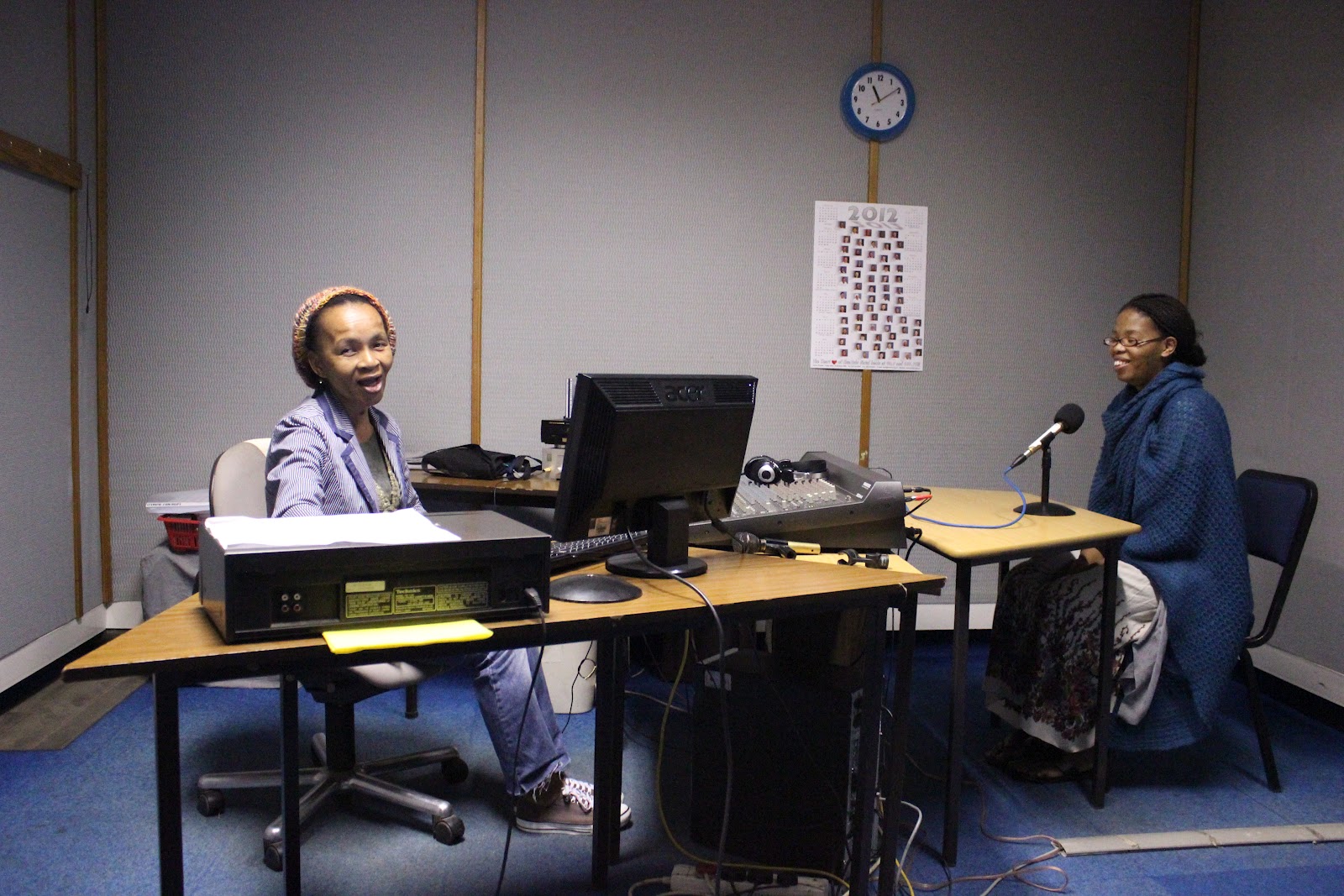
It was such a pleasure to travel to Kranskop on Saturday to visit the Kwasizabantu Mission.  The name pretty much means "place of help for the bantu people."  This entirely self sustained mission town was started by Germans in 1954.  Their radio station, Khwezi Radio, alternates between German, English, Afrikaans and other kinds of programs.  Phoenix staff and I had a blast talking about Phoenix's prison work with Nosipwe, one of Khwezi's their extremely talented radio hosts!

http://www.khwezi.org.za


Speaking with Nosiphwe about working with Phoenix as an SIT student and now as an Alice Rowan Swanson Fellow

Johnny's Roti's - A Rainbow Nation Microcosm


    The only place I've visited in Durban where people from every race, class, age and gender come together equally is Johnny's Roti's.  It is a literal hole in the wall on the side of a busy road with a kitchen, a window and a facade covered in loud, painted signs advertising "A Deal for Busy Housewives - 10 plain rotis for 10 rand!!!," "12 rand sugar bean rotis," and other meals for 10 to 50 rand.  One sign reads, "Feed the Hungry! 400 bunny chow's for 300 rand!"  (One American dollar equals about 8 rand, and a bunny chow is a quarter loaf of bread hollowed and filled with a meat curry, a unique invention of the Indian people in South Africa). 
    At the window a young Zulu girl takes orders and in the kitchen a colored man rolls mutton curry into a huge roti (which is similar to a chewy tortilla).  Waiting outside the window for their food you can find homeless black women, rich white business men, young indian surfers, mothers, children and tired construction workers.  Everyone goes there because you can buy a lot of really delicious food for a small price.  I take a bite of a warm chicken roti as I head back down the alleys towards my place, stepping over trash and enjoying the walk.