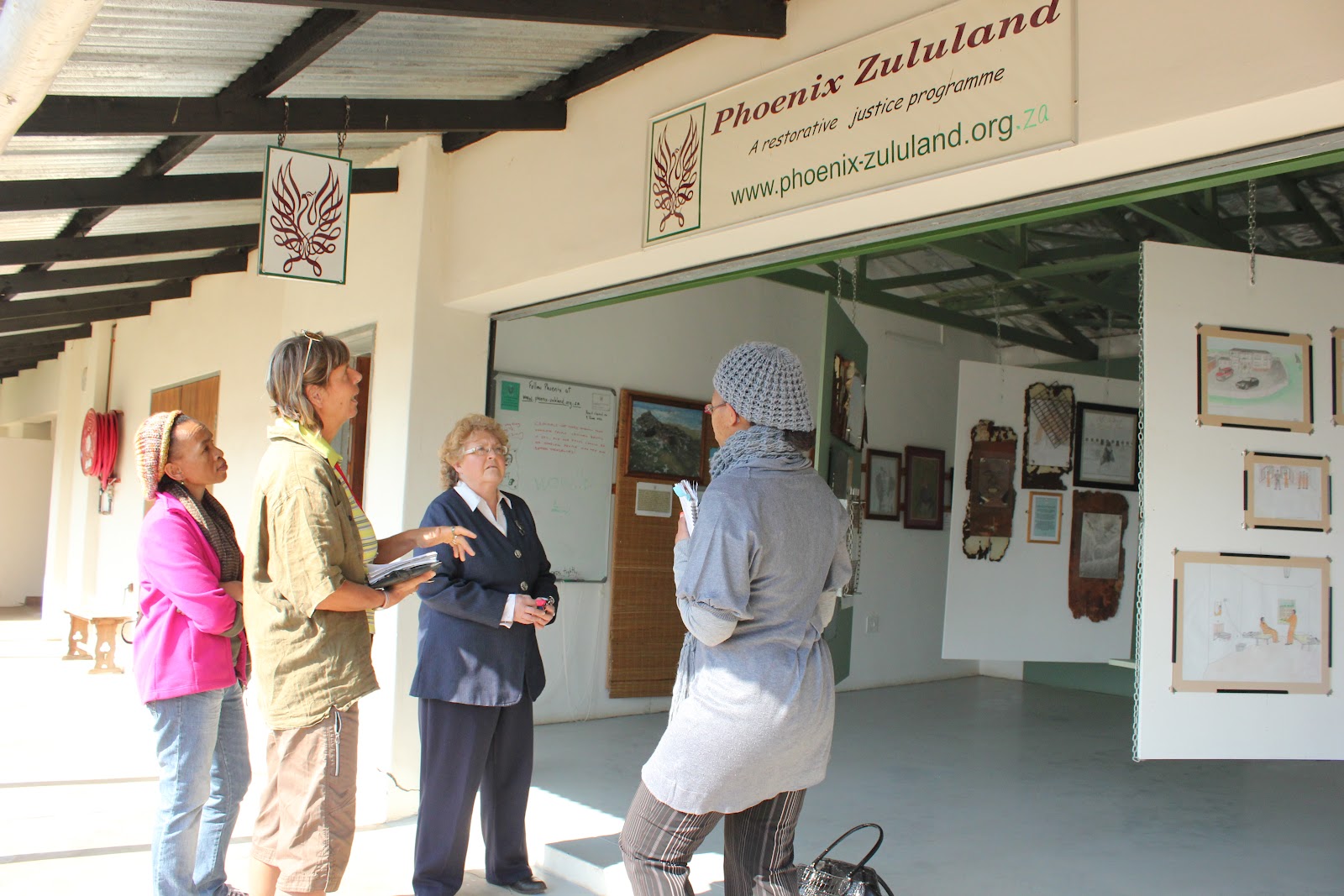
Friday, August 24, 2012

Photographing reconciliation

Ryan Lobo's experience photographing Liberian ex-war lord Joshua is an extraordinary picture of reconciliation (from about 3:00 to 6:00):

http://www.ted.com/talks/lang/en/ryan_lobo_through_the_lens_of_compassion.html

Tuesday, August 21, 2012

In America, Prison Painting Work Continues


The latest since returning to America:

-Over one hundred never before seen artworks have been added to the online archive of inmate artwork in the last month, including all of the images from my collaborative hand painting project.  I plan on having an "official release" of the website soon, but here is your sneak preview: http://www.prisonpainting.com

-I am grateful to the women who participated in the collaborative hand painting project for giving me ownership of their hand painting photos.  I have been preparing for an art festival on Aug. 25 and 26th in Alpharetta, Ga by making prints of the artwork from this project.  Half of all proceeds will go directly towards Phoenix Zululand!  Examples pictured above.

-You can support Phoenix right now by purchasing a print at http://www.etsy.com/shop/smckeestudio!

-Working with World Learning to produce a video summarizing the project.  The video is almost complete and will be published on World Learning's Youtube channel soon.

-Phoenix Director Nonceba Lushaba has nominated my project for the Patricia Smith Melton Art of Peace Award.  Hoping for the best!  

-Some recent press coverage.

Friday, July 20, 2012

Painting with Qomdeni

Qomdeni, myself and Phoenix Facilitator Thembaletu.  Photo by Jon.

On my last day at Eshowe Women's Prison.  It is a "plastic bag society" - everything brought into the prison must be in a plastic bag.
While painting for a second time with Qomdeni, she said "Before you came, I didn't know I could draw.  But now I have made drawings that I love."  She said she would have labeled everything in the drawing but no one would help her (she never learned to write).  I realized that drawing pictures is the closest thing she has to writing.

She does not have any drawing materials.  Today was my last day in the prison.  When I went in to give her the photo of her hand painting, I also gave her all my colored pencils, a pencil sharpener, a pencil case that was given to me years ago and some paper in a folder.  I hope she knows that she has given me much more.

Thursday, July 19, 2012

Wednesday, July 18, 2012

Saturday, July 14, 2012

How Should We Give Help?

Richard Aitkin's tongue-in-cheek revsion of a famous passage from the book of Matthew (orginal follows):

"'I was hungry, so you drew up budgets and formulated programmes which taught me how to sustain my dietary needs; I was thirsty, so you enabled me to launch and advocate for water projects so that I should not go thirsty again; I was a stranger, and people thought of me as the alien "other" and so you put me into language and enculturation classes so I could learn how to fit in; I needed clothes, so you budgeted for a sewing project and stressed that we must think about the sustainability of our team of sewing ladies; I was sick, so you came to the conclusion that I was not looking after myself well and my body's immune system was compromised, so you developed a healthcare programme and made me learn it; I was in prison, and so you contructed a very full programme whereby I could learn self esteem and also improve my job interview skills, so I would get a job and not be at risk of re-offending. " 

The (original passage) invites us to participate, with open hearts unconstrained by norms and standards: "For I was hungry and you gave me something to eat; I was thirsty and you gave me something to drink; I was a stranger and you invited me in; I needed clothes and you clothed me; I was sick, and you looked after me; I was in prison and you came to visit me.'" -Matthew 25:35-36

Thursday, July 12, 2012

What's Happening Outside of the Phoenix office

Sometimes the most exciting part of a plan is when it changes.  My role here has been more than I had hoped for.  In addition to my three initial goals (being a Phoenix Facilitator, painting on hands and making an online gallery) I am also:

-Helping plan and implement a three day facilitator training workshop


-All the cooking for said workshop

-re-doing the Phoenix gallery entirely (specifically I am working on curating, wall text, painting a mural on the outer door, and framing)


-creating a book about Phoenix that they can use as a marketing tool


Tuesday, July 10, 2012

Hearing Qomdeni's Story

Qomdeni, Nonceba and Jennifer in eShowe women's prison

Qomdeni's pattern has trees.  She hopes to work with the soil in the future.

As a child she sold plants with her grandmother, who has since passed.  Her hands are strong, and as I painted them, she told Nonceba her story.

Qomdeni is 32 years old.  She did not go to school.  She is one of eight children.  Her parents are gone.  One of her sisters left their homestead and married their cousin.

Qomdeni's cousin/brother-in-law came to their homestead demanding to make all the other sisters his wives, too.  She said no.  He raped Qomdeni.  She fled to Durban where she lived homeless on the beach.  A social worker returned her to her home, and she was raped by her cousin/brother-in-law again.

Qomdeni reported the rape to the police.  They came, took him away, and returned him the same afternoon.  Her cousin/brother-in-law taunted her for thinking she could stop him.  She fled again to Durban. 

A sister died so she returned to the homestead for the funeral.  Her attacker raped her again.

Qomdeni and her brother killed that man.

Qomdeni's sister reported the crime but the case was dropped.  Two years later the case was somehow re-opened.  This year she begins her 15 year sentence.

That is how she got in prison.

Monday, July 9, 2012

What's Happenin in the Phoenix Office

1. Organizing and choosing artwork to document


2. Documenting artwork
Jon Rinke, photographer
 
3. Documenting artwork - the tools

Mosquito net, light bulb, aluminum foil, zip ties.

4. Home


Sunday, July 8, 2012

Alcohol Abuse and Art

Paper covers the cans to allow sunlight and shadows to be more clearly seen.  Just like in life, advertising can make it difficult to see the truth about alcohol.


The lesson began with a value study to learn how to change watercolor from dark to light, just like we can change our lives from dark to light.

Phoenix facilitators Lamo and Jon, along with inmates, look at the subject of their paintings.


A surprising majority of inmates in KwaZulu Natal prisons were under the influence of alcohol when they committed crime.  In this section 10 of Phoenix's "Starting With Us" program, a facilitator leads inmates through a memoir exerpt that describes a woman's plunge into alcoholism.  They discuss the role alcohol has had in their lives, and talk about the kind of support needed by people who abuse alcohol.  Resources for support outside of prison are also provided.

Magdalena (a German art therapist) and I developed an art lesson to help inmates visualize these concepts.  I began by teaching them how to paint a value scale with watercolor.  Then we talked about the shape of the can we would draw, how the sunlight hits it, and how the shadow that is cast is the darkest part.  Magda dicussed how alcohol has a light side (fun, parties, friends) and a dark side (can cloud your judgment and cause you to become violent).  The positive side is that, just like we can lighten watercolor paint by cleaning the brush and removing the dark paint from it, we can clean up our lives by not abusing alcohol.

Saturday, July 7, 2012

Working with Women in Eshowe Prison

Last week I introduced my collaborative painting project to these women.  Almost all volunteered to help.  In this photo they are drawing pictures of what they want their future to look like.  I'm using these pictures to make patterns that I've been painting on their hands.  I have heard some amazing life stories so far, and can't wait to share more soon. 

Tuesday, July 3, 2012

Phoenix Planning


Jon Rinke, Ida Gartrell, Richard Aitkin, Magda Northaft, and Nonceba Lushaba


Ida Gartrell, Stephanie McKee, Magda Northaft and Nonceba Lushaba

Ida and Stephanie

Sunday, July 1, 2012

Khwezi Radio

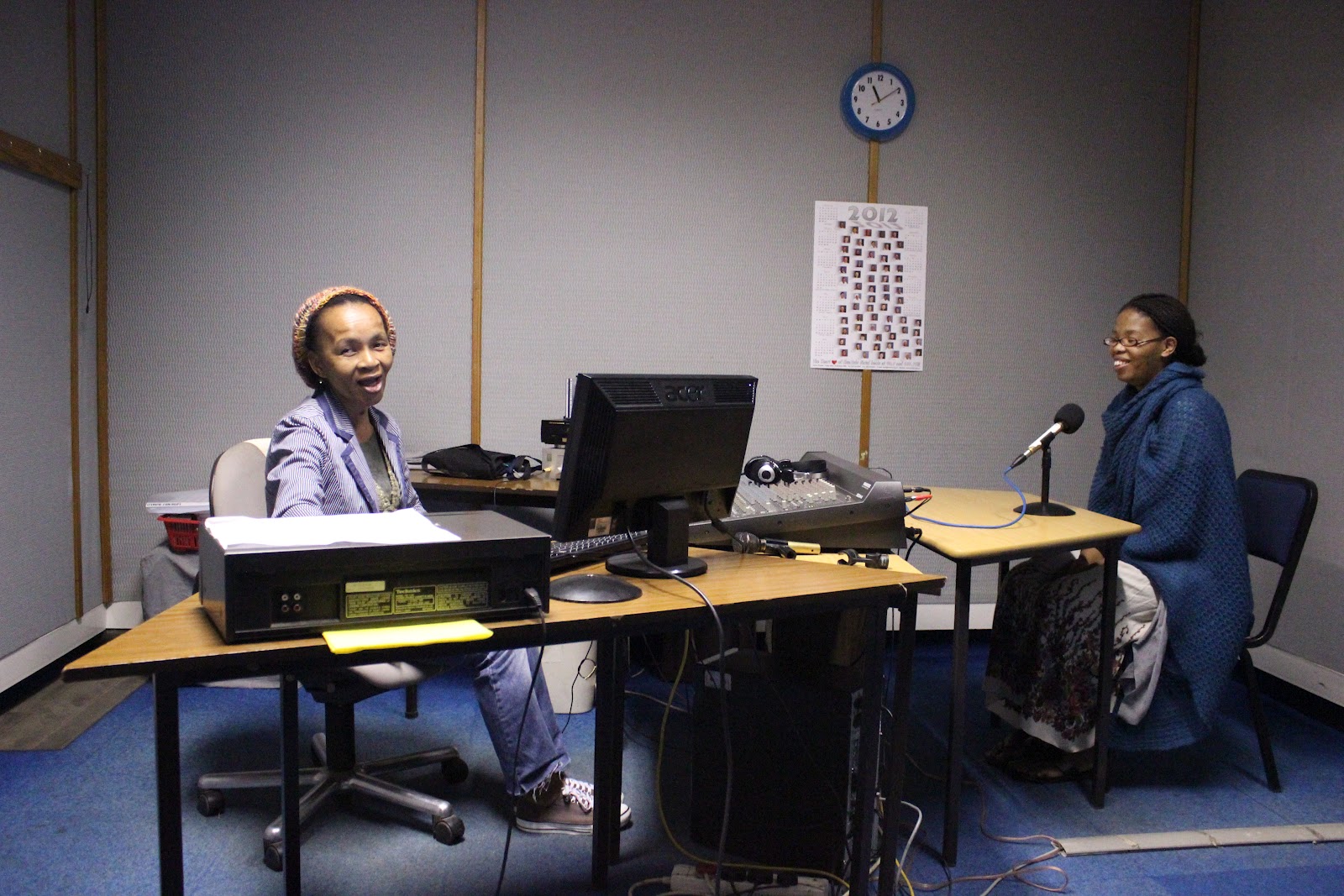
It was such a pleasure to travel to Kranskop on Saturday to visit the Kwasizabantu Mission.  The name pretty much means "place of help for the bantu people."  This entirely self sustained mission town was started by Germans in 1954.  Their radio station, Khwezi Radio, alternates between German, English, Afrikaans and other kinds of programs.  Phoenix staff and I had a blast talking about Phoenix's prison work with Nosipwe, one of Khwezi's their extremely talented radio hosts!

http://www.khwezi.org.za


Speaking with Nosiphwe about working with Phoenix as an SIT student and now as an Alice Rowan Swanson Fellow

Johnny's Roti's - A Rainbow Nation Microcosm


    The only place I've visited in Durban where people from every race, class, age and gender come together equally is Johnny's Roti's.  It is a literal hole in the wall on the side of a busy road with a kitchen, a window and a facade covered in loud, painted signs advertising "A Deal for Busy Housewives - 10 plain rotis for 10 rand!!!," "12 rand sugar bean rotis," and other meals for 10 to 50 rand.  One sign reads, "Feed the Hungry! 400 bunny chow's for 300 rand!"  (One American dollar equals about 8 rand, and a bunny chow is a quarter loaf of bread hollowed and filled with a meat curry, a unique invention of the Indian people in South Africa). 
    At the window a young Zulu girl takes orders and in the kitchen a colored man rolls mutton curry into a huge roti (which is similar to a chewy tortilla).  Waiting outside the window for their food you can find homeless black women, rich white business men, young indian surfers, mothers, children and tired construction workers.  Everyone goes there because you can buy a lot of really delicious food for a small price.  I take a bite of a warm chicken roti as I head back down the alleys towards my place, stepping over trash and enjoying the walk.

Wednesday, June 27, 2012

Did you know that South Africa does not have a death penalty?


This placard at the Constitutional Court in Johannesburg explains how South Africa's prisoners have the right to vote.  To the left of this placard is an image of Constitutional Court judges in front of nooses, and the reading states:

On 15 February 1995, the 11 judges took their seats to hear the first case. The case, S v Makwanyane, raised the question of the constitutionality of the death penalty

For three days the judges heard arguments. The facts of the case, in which Makwanyane had been sentenced to death, were not directly relevant: the core issue was what bearing the interim Constitution had on the death penalty. Did the death penalty violate sections 9, 10 and 11(2), which guaranteed every individual the right to life, the right to dignity and the right to be free from torture and cruel punishment?

In its judgment, handed down on 6 June 1995, the Court unanimously found that the death penalty was indeed unconstitutional.

Tuesday, June 26, 2012

From Joburg


Victim: My eyes well with tears as I imagine how I would feel if my younger brother was killed.  I am at the Hector Peiterson Memorial in Soweto reading the testimony of Hector's sister.  Hector was the first young victim of the Soweto uprising in 1976.  In front of me is a wall sized photo of Hector's body being carried by another boy, his sister walking alongside, hands spread wide next to her body, her mouth large and howling.
Offender: Another placard at the Memorial displays the words of a white police officer who tried to stop the rioting crowd of children.  They were rioting because they didn't want to be educated in Afrikaans, the language of their oppressor.  The policeman was pelted with stones, and he shouted for them to stop.  They advanced.  He threw tear gas.  They did not disperse.  He fired warning shots in the air.  To his dismay, his men began firing into the crowd.


Past: I am in Number Four, an old political and criminal prison in the heart of Joburg.  I imagine that it is 1962 and I am Mandela looking out over the city from my cell, trying to picture what it would look like as a new, free country.
Present: Today some of the old prison walls were laid down next to the prison.  They are a path that leads to the Constitutional Court, created to serve the people and protect their constitutional rights, which can be found here: http://www.info.gov.za/documents/constitution/1996/96cons2.htm

Monday, June 18, 2012

Hi from Athens, Ga!

Who is Stephanie?


What does your project entail?

How have your experiences prepared you to do this project?

How does this project fit into your sense of purpose as an artist?

Can I be a part of this project?


Thursday, June 14, 2012

A Traveling Inspiration


In my time working at the Athens YMCA, I learned about and met Fred  and Wila Birchmore, two of the most inspiring lives to come out of Athens in my opinion.  Fred lived from 1911 to 2012 with a spirit of kindness, adventure, achievement and service to his community that I can only hope to model my life after.  After Fred rode his bicycle around the world, he and Wila got married and bicycled through South America for their honeymoon!  I've never recommended an obituary, but his reads like a great adventure story that will make you want to pick up and go write your own!

Sunday, June 10, 2012

On Home


This home is not mine.  

Two weeks ago I packed my things into a small storage unit and in two weeks I will be in South Africa.  As with many twenty two year old's, I have spent recent years trying to find who, what or where home is.  After studying abroad in 2010 I arrived back to St. Pete, FL, to the house where I grew up and wrote this:

Getting to South Africa took
many papers.
Today they are in the trash.
My bedroom has changed little since
leaving and
the house
is quiet.
I don't know how I like my tea anymore.

Where can I go to remember myself?
The church, the mall,
a book, a meal,
my studio, my music,
running down the road?

I did not know where home was.  I was done with college and decided to move Athens, Ga, on account of love.  Here I have learned that if I expect my location, jobs, relationships or financial situation to make me happy, I will always be dissatisfied.  I have learned that for me, maturity is worshiping God no matter what circumstance I am in. 

In 2011, feeling brave for removing myself from school for a year, I applied to graduate schools and wrote this in an entrance essay:  "Taking a break from academia was difficult for me, not only because I love school, but because I was under the illusion that only with an advanced degree would I find the perfect job and only with the perfect job would I find contentment.  Now I'm pretty sure the  perfect job doesn't exist.  Even if I became the highly successful painter I wanted to be, if I bypass people, if I forget about serving people, I've missed the point."

A year of "real world" experience was not enough.  I did not get into an affordable grad school (I know, I'm crazy for thinking grad school should be affordable, but I can't afford to think otherwise).  I continued to struggle to feel at home and at peace with where my life was.

Today I cannot speak about a solution without speaking about God.  He changes my perspective daily.  I listened to a sermon recently that put it well: "Everything and everyone here is not home.  Unless you realize this, you will always feel estranged.  You will be always traveling and never arriving. God is the home we are missing.  God is the home we somehow remember - walking with Him in the garden in cool of the day, seeing His face.  He is the home our hearts are always longing for and Jesus has opened the door and paid the mortgage."

I am not home yet, and won't be while I'm in this flesh, but I am grateful to the Holy Spirit for allowing pieces of heaven to be realized on earth, and to Jesus for being the bridge back to walking with God in the Garden.  

J.R.R. Tolkein wrote that "Not all who wander are lost."  As I look forward to the privilege of traveling to a foreign country again, I remember that everywhere I go, and in every stage of life, if I am with God I am home.